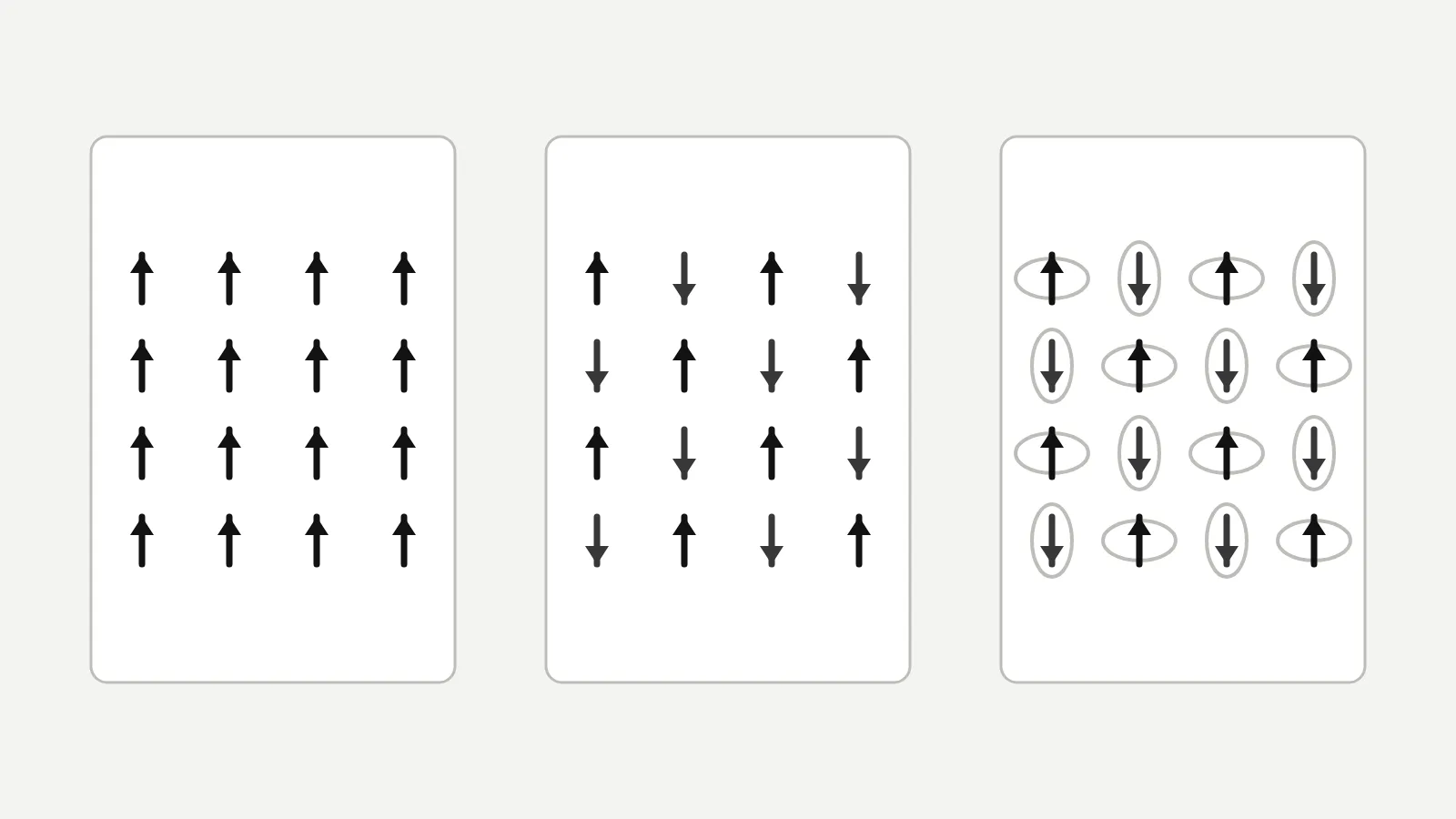
Magnets are usually sorted into two kinds. In a ferromagnet, like a fridge magnet, the tiny magnetic arrows of the atoms, called spins, all point the same way. In an antiferromagnet, neighboring spins point in opposite directions and cancel out, so there is no overall magnetic field.
A third kind, called an altermagnet, was proposed by theorists. It also has no overall magnetic field. The difference is in the crystal around each atom. In an altermagnet, the up-spin atoms and the down-spin atoms sit in surroundings that are rotated relative to each other. That rotation gives electrons spin-dependent behavior that ordinary antiferromagnets do not have.
What is new
A team led by researchers at SLAC and Stanford, with the European Synchrotron (ESRF) in France, published a paper in Science called “Chiral altermagnon in MnTe.” They studied manganese telluride (MnTe), a material long treated as a plain antiferromagnet.
They shined circularly polarized X-rays on it and compared how left-handed and right-handed beams scattered. The material showed a clear difference. The authors say this “handedness” signal is expected for an altermagnet and absent in conventional antiferromagnets. ScienceDaily reports that the experiment ran in 2024 and was repeated in early 2025 with the same result.
Read the word “proof” carefully
The press materials call this conclusive proof. That is the researchers’ wording. It is not the first evidence. In 2024, a Nature paper reported direct observation of altermagnetic electron behavior in MnTe, and a Japanese team posted a separate measurement of the same effect. The new work adds a different technique, X-ray scattering, and its title points to magnetic waves (altermagnons) rather than electron bands. It is best read as one more independent check.
What it could mean
Altermagnets are interesting because they could combine the stability of antiferromagnets with electronic behavior closer to ferromagnets. The physics papers describe possible uses in spin-based electronics, but these are predictions. The researchers say much work is still needed, including learning to control altermagnetic states with light and electricity.
One more limit: the summary we could read gives no measured values, such as signal size or temperature. The details are in the paper itself.
Sources
- Chiral altermagnon in MnTe (Jost et al., Science 394, 541, 2026) (primary)
- Altermagnetic lifting of Kramers spin degeneracy (Krempaský et al., Nature, 2024) (primary)
- Observation of giant band splitting in altermagnetic MnTe (Osumi et al., arXiv/Phys. Rev. B) (primary)
- SLAC scientists find conclusive proof of a mysterious third type of magnetism (ScienceDaily) (secondary)
- Scientists directly observed altermagnetism (Johannes Gutenberg University Mainz) (secondary)